|
Bernhard Arp Sindberg established a refugee camp in 1937 with German Karl Gunther and other expatriate workers. Provided to China Daily |
Cramped conditions
In his book, 1937-1938 and the Atrocities of Humanity, Dai describes conditions in the camp: "Huge crowds of people stood or sat next to each other. The sheds were very close; there wasn't even space for toilets."
Xia Quanliang and Su Guobao, two survivors from Hushan village, told Dai, "Our lives were worse than those of oxen and horses."
Sindberg was also quoted as saying: "Only God knows how those poor people suffered."
The Danish watchman and his colleagues established a hospital inside the factory to treat the sick and injured, although seriously ill people were sent to downtown Nanjing to receive treatment. Sinberg begged the Drum Tower Hospital and the Red Cross to provide nurses, medicine and bandages.
He also provided food and information for those who became isolated in the downtown International Safety Zone. Because it was located in a remote area of the city, the factory had a generator, which allowed residents to listen to radio reports about the progress of the war. In addition to saving lives, Sindberg also wrote a journal recording local events and took photos of the atrocities committed by the Japanese.
"Sindberg and a US priest, John Magee, who was president of the Nanjing Committee of the International Red Cross, photographed the disgusting acts committed by Japanese troops around the cement factory and the nearby Qixia Temple," said Jing Shenghong, a historian at Nanjing Normal University who specializes in studies of the massacre.
"He wrote letters to friends in his hometown of Aarhus, Denmark, describing the massacre in detail," he added.
On Feb 2, 1938, Sindberg handed his records of the massacre to John Rabe, the-then president of the Nanjing Safety Zone, and Lewis Smythe, secretary of the zone's international committee.
After being deported by the Japanese in March 1938, Sindberg traveled to Europe where he toured Denmark and Germany with an exhibition of his writings and photos as a way of alerting the world to Japan's brutal incursion into China.
In 1939, Sindberg left Denmark for good and headed to the US, where he lived until his death in 1983.
According to his niece, Marianne Andersen, Sindberg rarely mentioned his experiences in wartime China, and only opened up when he'd had too much to drink. "He never told me about his experiences of saving people from the massacre," Andersen said. "I think it remained a traumatic episode all his life. When you experience extremely horrible things, it's hard to speak about them."
Andersen, a keen gardener, bred a special yellow rose and named it the "Nanjing Forever - Sindberg Rose" after her late uncle. Dai sent her an e-mail in which he praised the flower, saying that yellow is the most exalted and honored color in China.
In April last year, when Denmark's Queen Margrethe II visited the Nanjing Massacre Memorial Hall, she praised the yellow roses on display in the Peace Hall. At the same event, Andersen, who was among the Danish invitees, met with Su to remember the victims of the massacre.
"Sindberg would have been an adventurous sailor without those 107 days at the cement factory," said Wu Xianbin, curator of the Nanjing Folk Anti-Japanese War Museum. "His heroic behavior meant he was regarded as a god by the people he helped to save."
To honor Sindberg's bravery, the local people sent a silk banner, 98 centimeters long and 36 centimeters wide, to their "savior", as they called him. Andersen donated the banner, which bears the words "The Good Samaritan" and was signed by 11 people, to the memorial hall in 2006.
For a scholar focusing on Australia's public diplomacy, working as a recreational manager in China may never be part of his career path. But Bradley McConachie does have lots to say now about his special experience at a resort in the picturesque tropical coastal city of Sanya in South China's Hainan province.

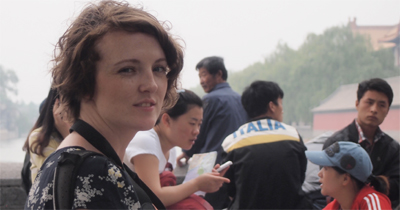
One of the potentially most traumatic things a girl has to go through is finding a new hairdresser.
Copyright 1995 - . All rights reserved. The content (including but not limited to text, photo, multimedia information, etc) published in this site belongs to China Daily Information Co (CDIC). Without written authorization from CDIC, such content shall not be republished or used in any form. Note: Browsers with 1024*768 or higher resolution are suggested for this site.
License for publishing multimedia online 0108263 Registration Number: 130349 



