



Makers of lucrative TCM cast net wider for future success









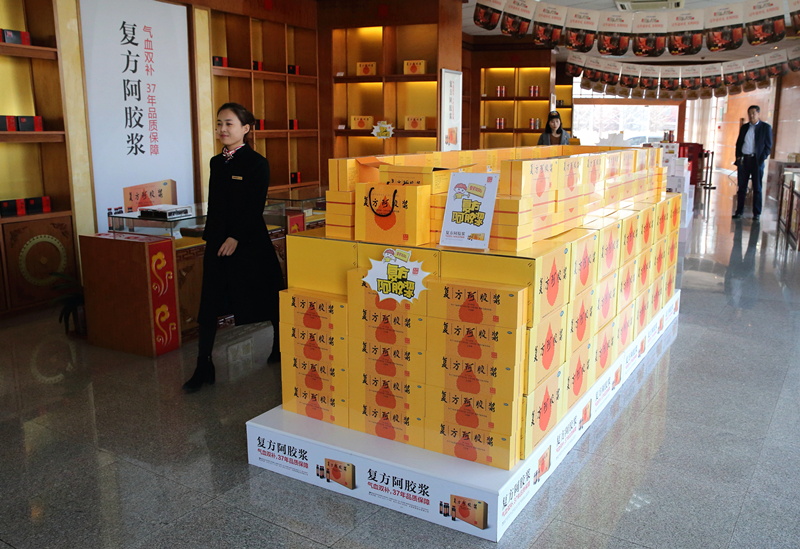
In 2014, Jiang Hongjun quit his job making gelatin for Dong-E-E-Jiao Co, China's largest producer of ejiao. The company is headquartered in Shandong's Dong'e county, which has a population of 40,000 people, many of whom work in the industry.
At the suggestion of his supervisor, Jiang left the factory and joined his mother in a venture to raise donkeys in Wangfengxuan, their home village, and exploit the rising demand for hides. Although startup costs were high, the family-run business was soon making 10 times Jiang's previous wage.
The then-35-year-old had misgivings about quitting his job, but his mother, Guo Fengxiang, had no such qualms, especially as the local government had recently introduced a policy to encourage families to establish donkey breeding cooperatives.
"I knew it was a booming industry, and the subsidy from the government basically guaranteed the farm's survival and allowed us to make more money," Guo said.
Initially, she and Jiang bought 300 foals from the Inner Mongolia autonomous region, but had no idea how to raise or breed them.
"By using common sense and the knowledge I'd gained from raising cattle, we survived the early years," the 70-year-old said.
The preparatory period was drawn out because while male donkeys, or jacks, can be fertile by the time they are 10 months old, females, known as jennys, don't come into heat until about age 2.
"Moreover, donkeys have a long gestation period - usually about 12 months - so about a year or so after the mating season I had to ask my son to consult some professionals and learn how to deliver foals. That helped lift our birth rate from 90 percent to 95 percent. However, raising the foals was hard work."
Their first batch of donkeys made a profit of 450,000 yuan. Though the sum was only equal to the average annual income of a middle-class urban family, it was a huge amount in Dong'e.
This year, Jiang and Guo will raise more than 600 donkeys and sell 90 tons of hides.
Despite his improved circumstances, Jiang still dresses in mud-splattered pants and an old jacket. He rarely discusses his earnings with his neighbors, many of whom work for Dong-E-E-Jiao.
Despite his early success, Jiang sees a black cloud looming. Last year, the price of donkey hides fell to about 20 yuan per 500 grams, compared with 23 yuan in 2016.
"In the first few years, the market price kept rising, but since 2016 it has flat-lined and even fallen" he said.


- Report blames management for deadly Yunnan tunnel flood
- Companies flock to Shanghai home appliances expo
- Three people perish in Guangdong house fire
- Experts: too early to tell if super El Nino will hit this year
- China recovers $4.95b in medical insurance funds in 2025
- China launches remote sensing satellite


