


Jade's royal seal of approval
Treasured artifacts from Xinjiang tell a story that extends beyond the Qing Dynasty's imperial court, Wang Kaihao reports.










When Emperor Qianlong (1711-99) ascended the throne in 1735, he inherited a court of wealth and a dynasty reaching its apex. Perhaps that partially explains why this Qing Dynasty (1644-1911) ruler nurtured such affection for fine art throughout his 60-year reign.
Jade, which in Chinese culture represents ritual and dignity, naturally became his focus.
On receiving a treasured jade piece, the emperor, who credited himself a member of the literati, would write a hymn and have it carved into the item.
The present-day Xinjiang Uygur autonomous region, particularly around the Kunlun Mountains, is famed for its jade production. Top-tier Hetian (or Hotan) Jade, which is named after the Hotan region, was among Qianlong's favorites.
In the Forbidden City, a story involving the royal court in Beijing and jade, which originated thousands of kilometers away, took on legendary status.
To mark the centennial of the former imperial palace becoming the Palace Museum, an exhibition recalling the saga of jade through 200-odd carefully selected pieces from the storerooms of the emperors is currently underway.
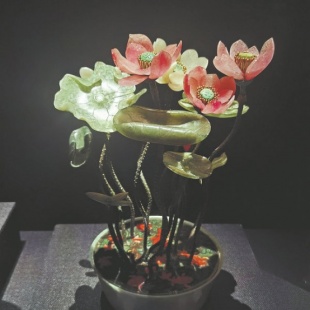
Jade From the Kunlun Mountains: Special Exhibition on Hetian Jade Culture in the Qing Court opened in the Zhaigong (Palace of Abstinence) Gallery on Tuesday and will run for a year. Items ranging from royal seals and ritual artifacts to carvings and miscellaneous articles of daily use demonstrate the versatility of Hetian Jade and the ways it can be transformed under the skillful ministrations of artisans.
"You can see the rich jade culture of the Qing Dynasty," Huang Ying, curator of the exhibition, says. "Hetian Jade is a pillar of Chinese jade culture."