



China's tech firm deploys AI model in orbit, unveils massive space computing plan









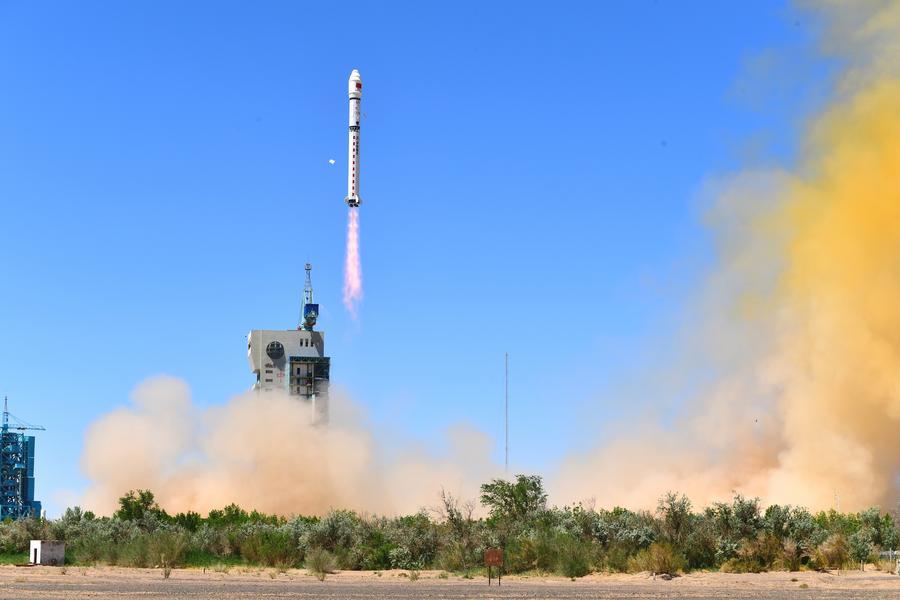
GUANGZHOU -- A Chinese commercial aerospace firm has successfully deployed a general-purpose AI model aboard its orbiting satellites, marking a major milestone for space-based computing.
The GuoXing Aerospace Technology announced at a seminar on Monday that it has uplinked the Alibaba's Qwen3 large language model to its inaugural space-based computing center, enabling end-to-end reasoning tasks entirely in orbit.
"This marks the world's first deployment of a general-purpose large-scale AI model from ground control to an operational satellite constellation in orbit," said Wang Yabo, executive vice-president of the Chengdu-based startup.
Last May, China launched a new constellation of 12 space computing satellites into orbit, the first cluster of GuoXing Aerospace's space computing project.
In the trial, the Qwen3 model completed multiple experiments, with questions transmitted from Earth to the satellite, processed on-board, and results returned to ground stations -- all within the space of just two minutes.
As AI fuels an insatiable appetite for computing power, a new field is emerging in the technological race as intelligent computing capabilities are pushed into space. In November, SpaceX rocket orbited the Starcloud-1 satellite mounted with Nvidia GPUs.
Wang outlined the firm's ambitions to build a sprawling network of 2,800 specialized computing satellites by 2035.
The planned constellation includes 2,400 inference satellites and 400 training satellites, deployed across sun-synchronous, dawn-dusk and low-inclination orbits at 500 to 1,000 kilometers altitudes.
The constellation is designed to employ laser inter-satellite links to facilitate high-speed data transfer, aiming to deliver 100,000 petaflops of inference compute and 1 million petaflops of training compute worldwide.
Its second and third satellite clusters are expected to be deployed this year, with a 1,000-satellite network completed by 2030, according to Wang.


