A celebration for a time of promise
Spring Festival enjoys a growing global profile with recent UNESCO heritage recognition. Zhao Xu explores the cultural roots of this age-old tradition and how it has evolved over time.










Illuminating ritual
It has long been a tradition for people — except young children — to stay awake throughout the night beginning from Chinese New Year's Eve. This custom, known as shou sui or the New Year's vigil, reflects a deep desire to safeguard what's most valued. The glow of lights is also expected to illuminate the path home for loved ones.
"The candlelit lamp's faint flame, obscured by the curtain, fades and dies; the incense on the brazier burns to ash and sighs." This is how an 8th-century Chinese poet beautifully depicts the stillness near the end of shou sui, as the long vigil approaches its close and night yields to dawn.
About 340 years later, Su Shi (1037-1101), a much-revered polymath of the Northern Song Dynasty and a contemporary of Wang Anshi, composed another poem for the occasion, under the title Shou Sui.
"To sense the year's end approaching; is like seeing a snake slipping into a ravine. Half its scaled body has already vanished away; who can stop its journey, or make it stay?" prompted Su, whose influence on Chinese culture as a poet, prose writer and painter is hard to overestimate.
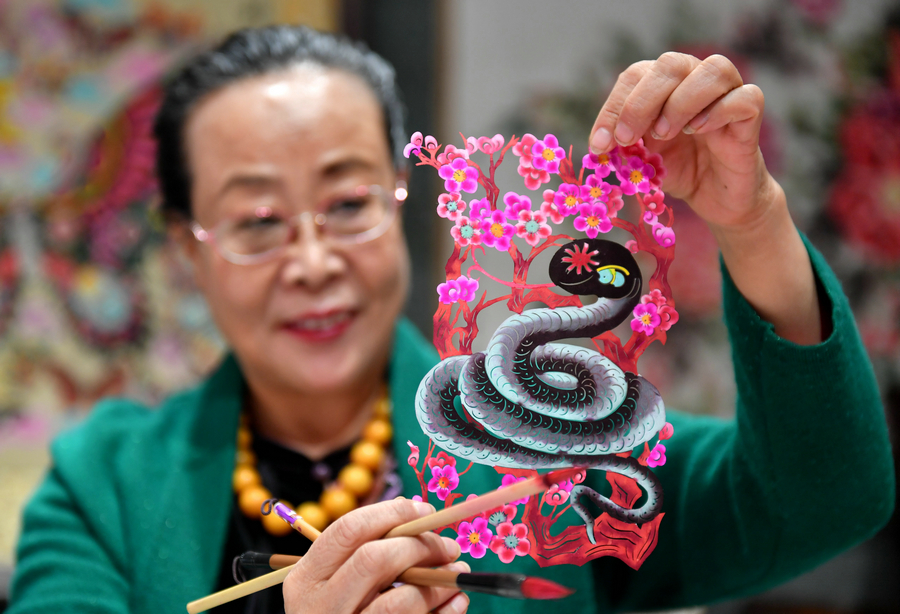
It's interesting to note that according to the Chinese zodiac, the upcoming New Year, beginning on Jan 29, marks the Year of the Snake, often referred to in Chinese culture as the "dragon minor". This connection stems from the snake's physical resemblance to the dragon, as well as its revered qualities — grace, mystery and power — which mirror those of the dragon, a symbol of might and virtue in Chinese culture.
Later in his poem, Su Shi, having sat for the whole night, "rose to peer at the slanting Northern Spoon".
The "Northern Spoon" here refers to the shape of the Big Dipper — a prominent group of seven stars that form part of the constellation Ursa Major (the Great Bear).
As one of the most recognizable star patterns in the night sky, especially in the Northern Hemisphere, the Big Dipper often marked the passage of time. Their tilting toward the horizon signifies that the night is drawing to a close and dawn is near.
Stargazing — that's what people in ancient China almost certainly did while waiting for the first rays of the new year.
In fact, at the core of the traditional Chinese calendar were the persistent advances in the art of astronomy and mathematics, integrated with the cultural, agricultural and political life of a society that believed the rule of heaven was the rule of law, with ultimate legitimacy resting in the reign of the natural order.
In their quest for greater accuracy and better alignment of the lunar and solar cycles, the Chinese, whose earliest evidence of timekeeping appears on oracle bones, also drew from other cultures.